
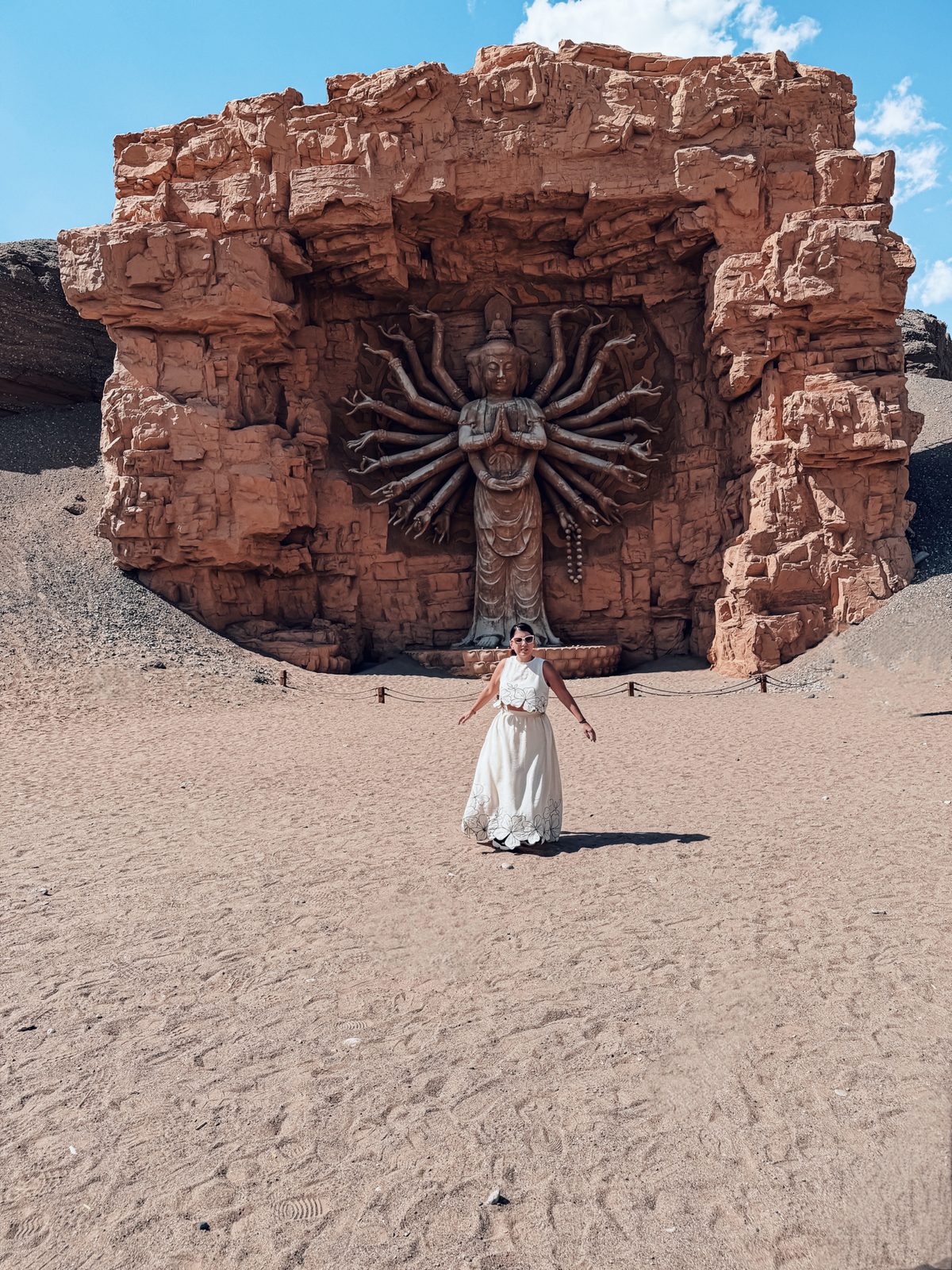
The Mogao Caves made me curious. There are 735 of them and your ticket opens eight, with only natural light and the guide's torch moving slowly across the murals. That quiet, almost secret way of seeing them is what makes the visit so special, and it's also why I came out wanting to discover more.
The good news is that the Chinese part of the Silk Road is one of the most digital heritage destinations I've ever visited. The Dunhuang Academy has been scanning the caves since the late 1980s, and today you can walk through them in 360°, open the famous Library Cave from your sofa, watch the desert come alive at night with light shows, and see how sensors and drones help protect it. Since my way of travelling is to immerse myself before I go, here's everything I found in Dunhuang and Zhangye. If you're planning the trip itself, read my Silk Road itinerary: Dunhuang & Zhangye in 4 days.
In this post: Before you go · On the ground · Behind the scenes
Before you go
The best part of the trip starts at home: step inside the caves, get in the mood, and set up your phone for China.
Step inside the caves from your sofa
The Digital Library Cave. The story of Cave 17 is pure Indiana Jones. In 1900 a Taoist monk living at Mogao found a sealed room hidden behind a wall, packed with tens of thousands of manuscripts, paintings and silk banners, untouched for about 900 years. Within a few years, explorers from Britain, France and other countries had carried much of it away, and today the treasures are scattered in museums around the world. The Digital Library Cave, made by the Dunhuang Academy and Tencent, brings it all back together: you enter through Cave 17 and explore the documents and the stories behind them in 3D. It's available in English and French, and it's the best thing to do the week before your visit.
Images: Dunhuang Academy, Digital Dunhuang and Digital Library Cave
Digital Dunhuang. The Academy's Digital Dunhuang website lets you walk through around 30 caves in 360°, moving along the passages and zooming into the murals in high definition. It's the only way to see the caves that aren't on your eight-cave route, and the details you'd never spot with a torch.
Images: Dunhuang Academy, Digital Dunhuang
The International Dunhuang Programme. Many of the Library Cave manuscripts ended up in the British Library, including the Diamond Sutra, the oldest dated printed book in the world. You can browse them for free on the International Dunhuang Programme website.
Get in the mood: watch, read, listen
Watch
- The Silk Road (1980), the legendary NHK and CCTV documentary series, with the iconic soundtrack by Kitaro.
- Dun-Huang (1988), the Japanese epic about the Mogao Caves and the manuscripts of the Library Cave, based on the novel by Yasushi Inoue.
- Hero (2002) by Zhang Yimou: part of it was filmed near Aksay, a short drive from Dunhuang.
Read
- The Silk Roads by Peter Frankopan, the big picture of how these routes shaped the world.
- Foreign Devils on the Silk Road by Peter Hopkirk, the gripping story of the explorers who carried away the treasures of the Library Cave.
- Tun-Huang by Yasushi Inoue, a short novel imagining how the manuscripts ended up hidden in the cave.
Listen
- Kitaro's Silk Road soundtrack, the perfect playlist for a night train across the Gobi.
- Yo-Yo Ma and the Silk Road Ensemble.
- Buddha Passion by Tan Dun, an opera inspired by the Mogao murals.
The apps I used on the Silk Road
- Trip.com: I booked all our flights, the train and every attraction ticket here, with no issues at all. You can pre-book trains before tickets go on sale, which is a lifesaver on routes with only a few trains a day.
- Alipay and WeChat Pay: China runs on mobile payments, and many places don't take cards or even cash. Set up at least one before you land: both now accept foreign cards.
- WeChat: the app for everything, from messages to mini programs, and how most people will ask to stay in touch.
- Didi: the Chinese Uber. We used it everywhere in Dunhuang, and it's cheap and quick.
- A translation app: don't expect anyone to speak English in Gansu, so keep one ready, ideally with photo and voice translation.
On the ground
What to look out for along the route, from the caves of Dunhuang to the Rainbow Mountains of Zhangye.
Dunhuang: at the Mogao Caves
Image: Dunhuang Academy, Digital Dunhuang
The visit itself opens with tech: two films at the visitor centre, one of them in a 360° dome theatre with the murals all around you. I tell you more about them, and how to follow them in English, in my Silk Road itinerary.
There's also a VR experience of Cave 285, one of the most beautiful caves at Mogao, which is closed to protect it. With a headset you step into a 3D reconstruction, fly up to the painted ceiling and even play drums with the mythological creatures of the murals, in about 10 minutes.
Dunhuang after dark
Encore Dunhuang is a walk-through immersive show by Wang Chaoge, co-director of the Beijing Olympics opening ceremony: you move through rooms and stages, through 2,000 years of Dunhuang history. We didn't make it this time, but if you have an extra evening, this is the one tech lovers talk about.
Ancient Sound of Dunhuang is a huge cultural complex with an immersive cave theatre: you follow the main character deeper and deeper into the "cave", with music and dance inspired by the murals.
Zhangye: the Rainbow Mountains after dark
The Zhangye Danxia is spectacular by day, and the park has added an immersive night show in the Tulin Valley, part of the Danxia scenic area. It mixes light, sound, music and digital art with the rock formations, and was created by artists who worked on the Beijing Olympics opening ceremony.
Behind the scenes
Technology isn't only there for visitors. It's also working to keep all this from disappearing.
Sensors in the Mogao Caves
Every cave open to visitors is monitored for humidity, temperature and carbon dioxide, and closes to recover when the levels get too high. That's why the caves on your ticket rotate (more on this in my Silk Road itinerary). In July 2026 the Dunhuang Academy also opened a Digital and Smart Laboratory, using AI, big data and VR to study and protect the caves.
Drones against the desert
The Hexi Corridor, the chain of oasis towns the Silk Road follows through Gansu, is in a constant fight with the sand. In Jinta county, drones carry materials across the dunes for sand barriers, and near Wuwei desert plants grow under rows of solar panels, anchoring the sand while the panels produce clean energy.
Bringing the caves to a new generation
The Mogao murals have even made it into Honor of Kings, one of China's most popular mobile games, with character skins designed from the cave paintings. It's one of the ways the Academy is bringing the caves to a generation that will probably never see them with a torch.
Ready to go? Here's my Silk Road itinerary: Dunhuang & Zhangye in 4 days.
 More from ChinaSilk Road itinerary: Dunhuang & Zhangye in 4 days