Chongqing in 3 days: Liziba, Hongyadong, Wulong karst, the drone show & the Tianyan Cave
3 days
14 stops
Aug 2026
Updated October 2026
After the desert of the Silk Road, Chongqing felt like landing in the future. A megacity of more than 30 million people built on mountains and rivers, with monorails running through buildings, streets stacked on top of each other and a skyline that lights up every night like a film set. People call it the 8D city, or cyberpunk, and after a few days there I understand why.
A 4D city. You walk along a street that looks like the ground floor, and suddenly you're on the 22nd floor. Everyone in Chongqing is fit, because of the stairs you climb just to get from one place to the next. Forget the maps: it's impossible to understand all the levels and shortcuts. Either stick to DiDi, as we did, or book a proper walking tour so a local can show you all the tricks.
It's also a city that's still opening up to the world. In the centre we saw many more Westerners than in Dunhuang and Zhangye, but go one or two hours out, to the karst of Wulong or the Tianyan Cave, and you're back among mostly Chinese visitors. We had three nights, but we landed around midnight on the first one, so in practice we had two and a half full days: one for the city, one for Wulong and the drone show, and a last morning underground in the Tianyan Cave.
How long to stay: 3 nights and 4 days, arriving early on the first day, so the city gets a full day and a full evening. Chongqing is a night city, and the nights are what you run out of: one for Hongyadong, one for the drone show (it only runs at weekends, so plan around it) and one for the cyberpunk streets and night photos, which we didn't have time for. The traffic is very bad, a ride across town at night can take an hour, and the lights go off at 11pm, so you can't fit many night spots into one evening. Go slower than we did.
What I'd add with one more night: proper cyberpunk photos. Chongqing is lit up like a film set, with a skyline that glows in every colour. I live in Dubai and I'm used to towers, but China goes to another level. There are photo tours that take you to the right spots at night, with props. And I'd have loved to eat hotpot at one of the riverside terraces where you can watch the drone show from your table. You can't book: you have to get there before sunset to grab a seat, which coming back from Wulong was impossible.
Before you book · nights, hotels & getting around
When to go: spring or autumn. We went in August, and it wasn't the right time: very hot and humid, and with all the stairs it was challenging at times. We were lucky that it didn't rain, which with that humidity is quite possible. It was feasible, but in another season you'd enjoy it much more.
Getting there: we flew in from Zhangye and out to Shanghai. Chongqing Jiangbei airport is about 30 to 40 minutes from the centre by DiDi or metro Line 10 and Line 3. The high-speed train connects Chongqing with Chengdu in about an hour.
Where to stay: somewhere central, in Yuzhong near Jiefangbei or Hongyadong. We stayed at the Yolo hot spring design hotel: nice, but a bit far down the river, and with this traffic that matters on a short stay.
Getting around: the metro is cheap and goes everywhere, including the monorail lines through the buildings. For the rest, DiDi, as we did. Keep your hotel address saved in Chinese, and leave plenty of time: the traffic is very bad, especially in the evening.
8 stops · swipe or tap a card
Read the story ↓
Morning30 min
Yangtze River Cableway
Over the river in a cable car
A cable car straight across the Yangtze, 1,166 metres from the old town to the south bank, running since 1987. It used to be how people commuted across the river. Today it is one of the classic views of the city stacked on its hills, and the crossing takes about five minutes.
Book it in advance. We didn't, and when we got there the queue was already so long that we had to give up. You can buy the ticket on Klook, or on the official WeChat account up to two days ahead: you get a queue number and board when it is called. About 30 CNY one way, 50 CNY return.
Tips
Start from the south station (Shangxinjie, metro exit 2, then about 8 minutes on foot). It is usually less crowded than the north station in the old town, especially in the evening: after about 8:30pm it is often close to walk on.
Go one way and come back by metro, so you only queue once. Riding from the south also gives you the old town and its towers in front of you the whole way.
Check the WeChat account on the day: it shows the live queue at both stations, and the line closes for maintenance one day a month and in fog or storms.
No fast lanes. Anyone selling you a skip the line ticket on site is a scam.
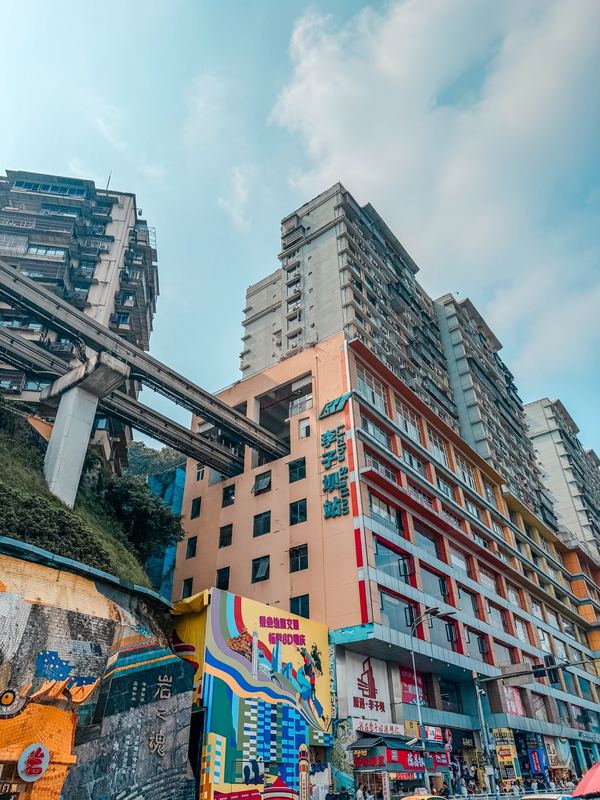
The famous stop where the monorail of Line 2 runs straight through a 19-storey residential block, between the 6th and 8th floors. The line opened in 2005, and the building was designed around the station, which shares its floors with people's homes. There's a free viewing platform below (exit 2), built in 2018 once the station had become a tourist attraction.
The train itself is fun, but the people are more fun to watch. Everyone stands there with their mouth open, timing the photo so it looks like they're eating the train. And of course a tourist spot calls for photographers, professional or amateur, ready to sell their services and promising you the best picture ever.
Tips: go early in the morning, between 7 and 9, for softer light and fewer people. Trains pass every few minutes. Until the end of December 2026 the station is being renovated in stages, so some exits may be fenced off.
Morning45 min
Baixiangju
The stacked city
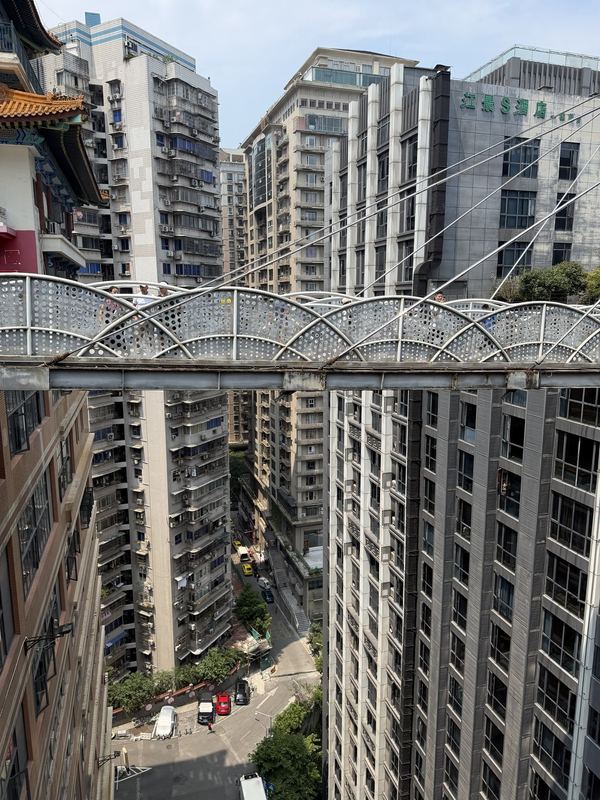
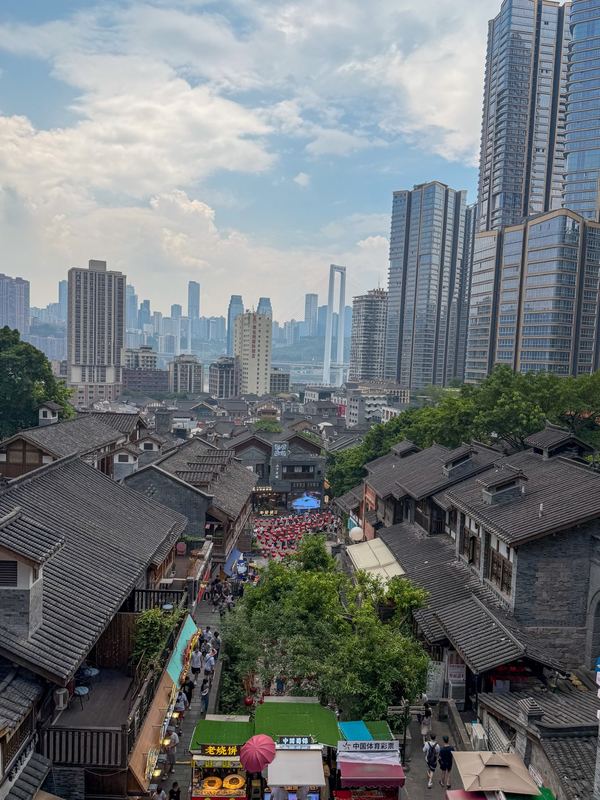
A block of six linked residential towers, up to 24 floors, built against the cliff in 1993. There are no lifts: instead it has exits onto different streets on the 1st, 10th and 15th floors, and sky bridges between the towers, so shops on the same walkway have different floor numbers. It's the classic example of the 8D city, and it has been a film set many times, from Chongqing Hot Pot (2016) to Better Days (2019).
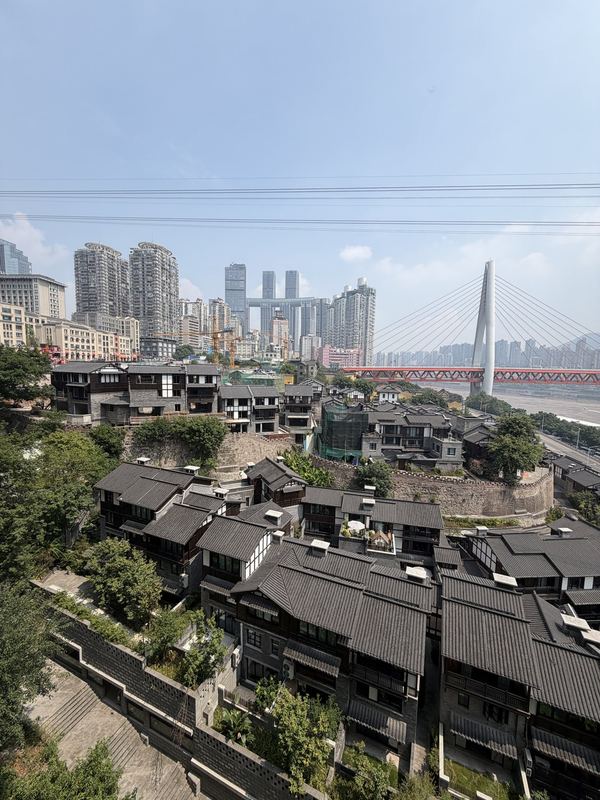
People still live here, so keep your voice down. From the upper levels you look out over the grey tiled roofs of the old town to the river and the bridges.
Morning30 min
Kuixing Tower
The ground floor on the 22nd floor
The best place to understand Chongqing's levels. You walk into Kuixing Tower plaza from the street, take the lift, and step out on the 22nd floor onto another street, connected to the next towers by sky bridges. Look over the railing and the road you were just on is far below.
Good to know: free and open all the time. Metro Line 2 to Linjiangmen, exit B, then about five minutes on foot. It's even better after dark, when the bridges light up.
Morning1h 30
Eighteen Stairs
Lanterns, shops and the old city
An old stepped neighbourhood that linked the upper town around Jiefangbei with the lower town on the Yangtze. It goes back to the Ming and Qing dynasties, and takes its name from the eighteen flights of steps between the two. During the war it was also the site of the worst air-raid tragedy in the city: on 5 June 1941 thousands of people died crushed and suffocated in the shelter tunnel under Eighteen Stairs. It was rebuilt and reopened in 2021 as a pedestrian area, and it's free.
It's very touristy, with a lot of shops, but it's very pleasant and lovely, full of cute things: lanterns over the lanes, little courtyards, snacks and souvenirs. This is where we found the panda ice creams, and the plush hotpot with its chili peppers.
Start from the top. Take a DiDi to the top and walk down the stairs. A bit less exercise (don't worry, you'll do plenty anyway), and from the top you get a beautiful view of the pagoda roofs against the city skyline.
Lunch1h 30
Air-raid shelter hotpot
Lunch in a wartime tunnel
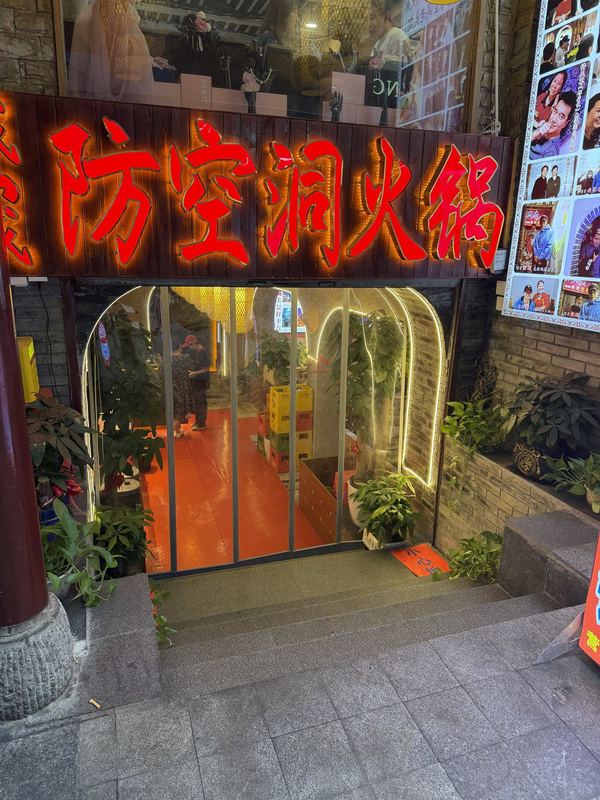
Chongqing is the capital of hotpot, and the most famous way to eat it is underground. Between 1938 and 1943 the city, then China's wartime capital, was bombed by the Japanese air force more than 200 times, and people dug hundreds of air-raid tunnels into the rock. Today many of them are restaurants, and they're also about 10 degrees cooler than the street, which in August is half the point.
There are a few in the city. The one we had searched for was closed, so we went to another. There's one near Eighteen Stairs which is probably the biggest, and of course the most crowded, but it's easy to reach. Hotpot is always good, because you choose what goes in the pot. If, like me, you don't like a lot of things and a lot of vegetables, it's the easy option.
Was it spicy? Not too much, because you can ask for a non-spicy broth. But Chongqing was part of Sichuan until 1997 and eats like it, so there are chili peppers everywhere, even on the plush toys.
Tips: check on the maps app that it's open the day you go, arrive when it opens to skip the queue, and if you don't eat spicy food ask for a split pot (鸳鸯锅, yuanyang guo), half spicy and half mild. Expect about 80 to 120 CNY a person.
Evening1h 15
Chongqing 1949
A show on a rotating stage
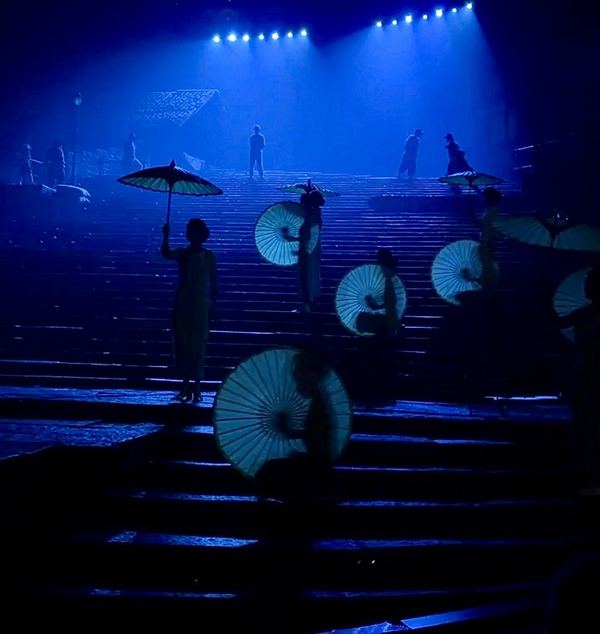
A huge stage show about the last days before the liberation of Chongqing, in November 1949. It follows three brothers, Lin Zijie, Lin Zihao and Lin Zixiong, caught between their family and their country, and the Communist prisoners held in the Zhazidong and Baigongguan jails, the prisons of the Nationalist government in the hills above the city. It ends with the gunfire of the liberation.
The theatre was built for this one show, in the Ciqikou old town area, and it's the star as much as the actors. The stage is made of five rings that each turn a full 360 degrees: three for the sets and the performers, and two that carry the stage and the audience at the same time. So the scene moves around you, and every few metres there's a new street, a staircase, a prison, a square full of people. Performers fly over your head on wires, it rains on stage, and the cast is enormous.
Is it worth it if you don't speak Chinese?
Yes. It's all in Chinese, and we arrived a little late and forgot to ask for the translation headset, which they do provide. Honestly, it didn't feel like we missed anything. With the rotating stage, the flying actors and the number of people on stage, it was never boring. It was amazing, really impressive, and if you are in Chongqing I'd tell everyone to go.
Book the rotating seats. I strongly suggest it: part of the audience sits on the rings that turn with the stage, so the scenes come to you and you travel through the story. It's a totally different and better experience, much more immersive. When you book, choose a seat in the A or B zones, the ones that move. A is closest to the stage. B is a little further back, more central and turns less, with a wider view.
Good to know
Shows: daily at 14:00, 16:00 and 19:30, about 70 to 75 minutes. Doors open 30 minutes before.
Tickets: from about 199 CNY, up to 599 CNY for the best seats (2025 prices). The rotating A and B zones start at about 279 CNY. Book ahead on Trip.com, tickets are not refundable, and bring your passport to collect them.
Translation: ask for the headset at the entrance (English, French, Spanish and Indonesian). There is a refundable deposit.
Getting there: the theatre is outside the centre, in Shapingba, and with Chongqing traffic it takes a while. Leave early, or take metro Line 1 to Ciqikou.
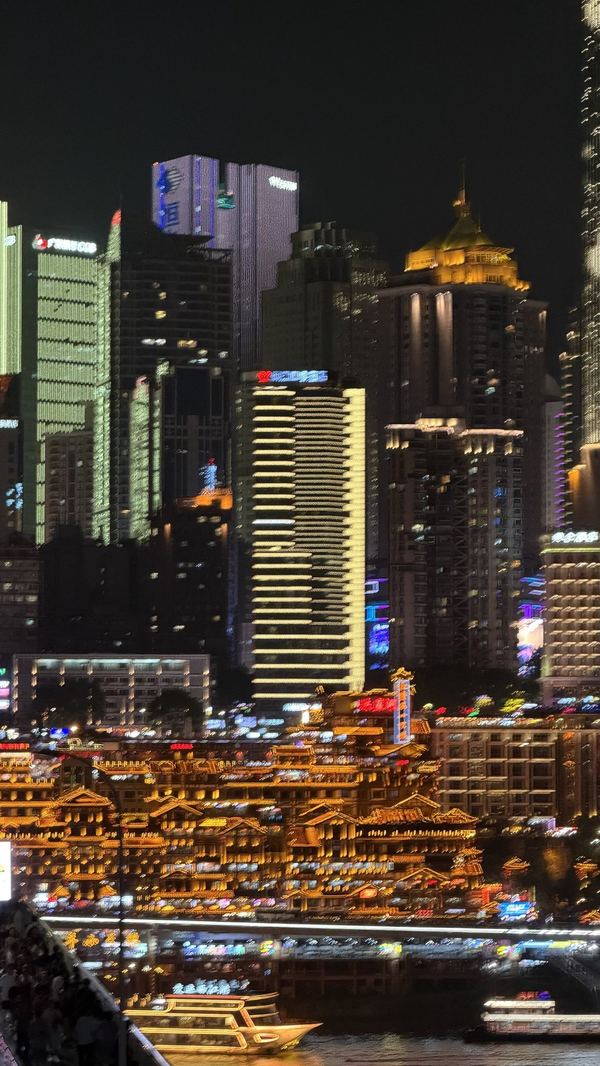
Eleven floors of wooden stilt houses stacked against the cliff above the Jialing River, lit gold at night. It looks centuries old, but it was built in 2005, in the style of the traditional diaojiaolou, the timber houses on stilts that once lined Chongqing's riverbanks. Since 2017 it has gone viral for looking like the bathhouse in Spirited Away, and it gets 10,000 to 20,000 visitors a day.
Good to know
Lights: on around 7:30 to 8pm in summer, off at 11pm. The bridge lights switch off before the building.
Best views: from the middle of Qiansimen Bridge, or from the Jiangbei side opposite (metro Line 6 to Grand Theatre). Inside, enter from the top on Cangbai Road and walk down.
Crowds: free, but at weekends and on holidays you may need a free time slot booked on WeChat. The lifts are worst between 8 and 9:30pm.
4 stops · swipe or tap a card
Read the story ↓
Morning30 min
Wu River viewpoint
The first stop on the way
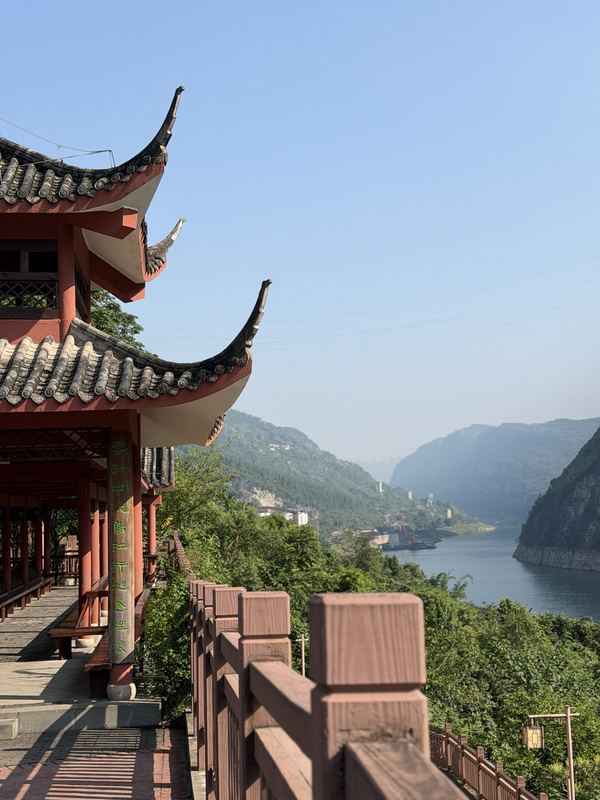
Wulong is about 120 km from central Chongqing, two to two and a half hours by road. We went with a small-group day tour5% off with code LINECCEPIBILE5, and the first stop on the way was a pavilion high above the Wu River, with green cliffs dropping straight into the water. A good place to stretch your legs before the karst.
AfternoonFull day
Three Natural Bridges & Longshuixia Gorge
Sky platforms, cliff lifts and a lot of stairs
Wulong was impressive. I don't want to say more than Zhangjiajie, the Avatar mountains, because that's also a crazy, crazy natural spot, but this one still felt like a hidden gem: mainly Chinese tourists and just a few Westerners. The landscape is karst, limestone that water has been dissolving for millions of years into sinkholes, gorges and bridges of rock. It's part of the South China Karst World Heritage Site since 2007.
Sky platforms and giant lifts
We started with a glass sky platform over the drop. You know the Chinese love a sky platform, a sky bridge, a sky anything. They also love a lift, and here there's a massive one bolted to the cliff that takes you down most of the way. Then you keep going on foot.
Get ready for stairs. A lot of them, and there's no other way out. At Longshuixia alone, after an 80-metre lift down, there are 508 steps to the bottom of the gorge, and at the Three Natural Bridges two cliff lifts of about 80 metres take you down before a route of about 4 km. It's not a mountain hike, the rest is mostly flat, but if you have problems with your knees it will be a bit challenging. At the very end the path climbs back up, and there's a small electric cart for the last stretch if you need it.
The Three Natural Bridges
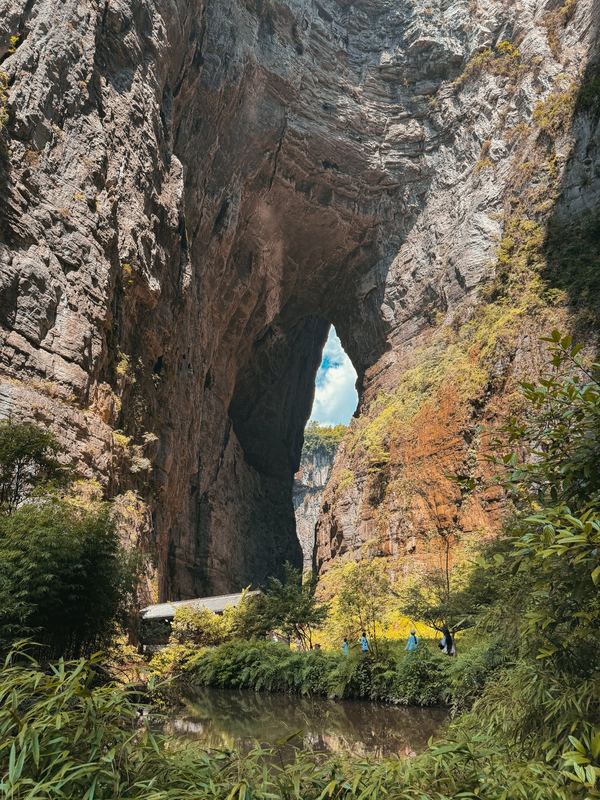
Three huge arches of rock over two sinkholes, the largest group of natural bridges in the world: Tianlong (Sky Dragon), Qinglong (Green Dragon), the tallest at about 281 m, and Heilong (Black Dragon), the longest. You walk along the bottom of the gorge and look up through the openings at the sky.
The wooden inn in the middle of the valley is the Tianfu Post. It looks old, but it's a film set, built for Zhang Yimou's Curse of the Golden Flower (2006). And if the cliffs look familiar, Transformers: Age of Extinction (2014) was filmed here too, which is why there's a Transformer statue at the entrance.
Longshuixia Fissure Gorge
The second part is a fissure, a crack in the rock so deep and narrow that in places the light barely gets in. The path is a platform hanging on the cliff side, over the river, with bridges and a tall waterfall in the middle. Very exciting.
Totally recommended. It's a bit far, but it's absolutely doable as a day trip and worth the ride. We were back in the city just in time for the drone show.
Good to know
Tickets: Three Natural Bridges about 125 to 155 CNY depending on the season, with the compulsory shuttle bus and the lift. Longshuixia about 85 to 105 CNY. Timed tickets, book at least a day ahead.
Opening hours: roughly 08:00 to 17:00 in summer, 08:30 to 16:30 from September to April.
On your own: since June 2025 a high-speed train runs from Chongqing East to Wulong South in about 35 minutes, then a coach of about 50 minutes up to the visitor centre. Don't confuse it with the old Wulong station.
Easiest: a day tour with pickup in the city, about 12 hours in total.
GetYourGuide 5% off every tour with my code LINECCEPIBILE5
Evening20 min
The drone show
Thousands of drones over the two rivers
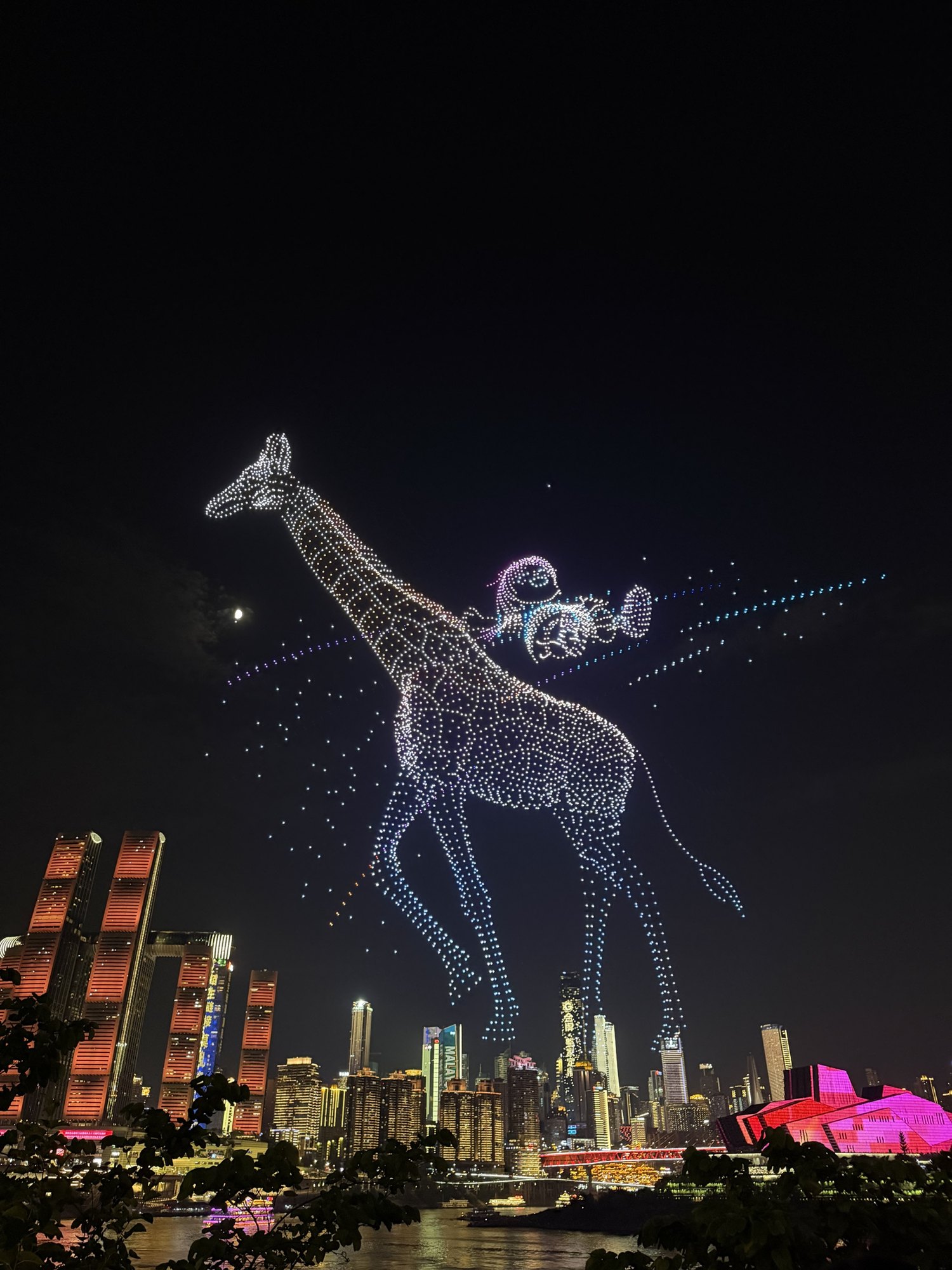
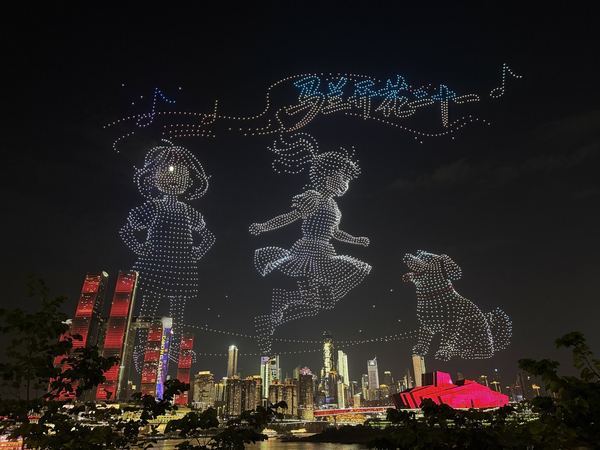
Crazy, crazy. Every Saturday evening about 5,000 drones lift off over the point where the Jialing River flows into the Yangtze, and draw pictures in the sky above the skyline: a giraffe, children playing with a dog, a car, scenes from the Chinese calendar. We were close to the area where they take off and land, so we saw them rise and come back, and in between they arrange themselves into figures that look almost 3D. It's massive, and it's really something you have to see. I live in Dubai, and all the drone shows we see at home are nothing compared to the Chinese ones.
There's a bit of advertising too, but when it's done with drones even a little ad is pleasant enough.
Good to know
When: Saturdays at 20:30, plus public holidays, for about 15 to 20 minutes. It has run since April 2025. Plan your trip so you have a Saturday night in town.
Check before you go: rain cancels it, and so do the Saturdays that are official working days in China. The local WeChat account 重庆本地宝 publishes each month's dates. Send it the word 无人机.
Where to watch: free from the riverbanks. The classic front view is the south bank, along Nanbin Road around the 长嘉汇 Changjiahui mall terraces (4th and 6th floor), facing the confluence. Chaotianmen is closer but you see the writing in reverse. Jiangbeizui is side on and quieter.
Arrive early: at least an hour before, it gets very crowded. Afterwards skip the taxis and walk to Danzishi metro station.
Night2 h
SHUA sky bar at Raffles City
Drinks inside the horizontal skyscraper
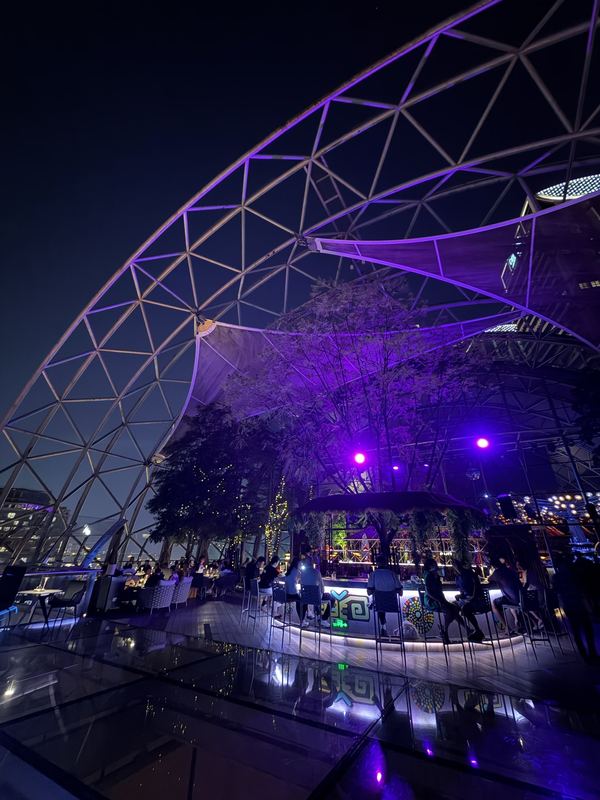
After the drone show we went for a drink at SHUA, the bar at the glass end of The Crystal, on top of Raffles City. Raffles City is the cluster of towers at Chaotianmen, at the tip of the peninsula where the two rivers meet, designed by Safdie Architects (the same studio as Marina Bay Sands) and opened in 2019. The Crystal is a horizontal skyscraper lying across the top of four 250-metre towers: a glass tube 300 metres long with gardens, restaurants, an infinity pool and a glass-floored observation deck 250 metres up.
Right: Raffles City Chongqing by Junyi Lou, Wikimedia Commons, CC BY-SA 4.0
We had dinner with small plates to share and drinks. It had been a long day, and after all those stairs in Wulong we really needed that drink.
Mind the traffic. The ride from the drone show took us an hour, for a distance you could almost see across the river. In Chongqing you can't fit many night spots into one evening, so pick one or two.
2 stops · swipe or tap a card
Read the story ↓
MorningHalf day
Tianyan Cave
Abseiling down to a giant Buddha
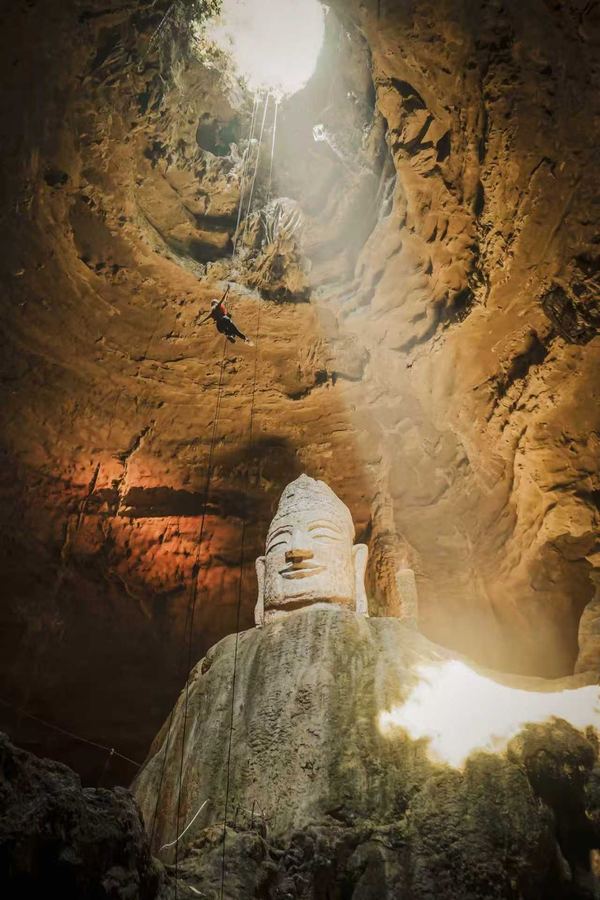
If Chongqing is becoming mainstream (in the city we saw many more Westerners), Wulong and this cave are still off the beaten track, and the cave even more. Tianyan Cave, 天眼洞, the Cave of the Heavenly Eye, is in the Hualing scenic area in Beibei, about an hour and a half from the centre. It's a karst cave over 800 metres long, and the name comes from the round hole in its roof, the eye, that lets the sky in. On a sunny morning the light falls through it like a beam.
The Buddha in the cave
Under the opening sits a stone figure about 33 metres tall, a seated Buddha shaped out of the rock. Online you'll read that it's centuries old, from the Qing dynasty, but the local town government says there is no historical evidence for it. According to the people who run the site, it was carved later, following the shape of the cave. So it's a new landmark, not an ancient one, but in that light it doesn't matter much.
The abseil
You go down on a rope through the eye, with the Buddha in front of you. I've done abseiling a few times before, down waterfalls in Bali and on a cliff in AlUla, and this one isn't scary: you're mostly just being lowered, so it's even less of a physical challenge than real abseiling. It's quick, but it's fun, and the photos are the point.
And here the Chinese are very well organised. There are photo spots and photographers ready to take the most amazing influencer-style photos, with props. When we arrived they made us wait and didn't let us go down yet, because the light through the opening wasn't right for the pictures. On site we upgraded to a drone video and eight photos with props (we negotiated the drone a little, about US$25). They give you a QR code and a number, they send everything on WeChat, and the same night, while we were at the airport, we already had the edited video and all eight photos. The video looks crazy, go and watch it on my Instagram.
How we did it
We booked a tour with transport, abseiling and a hotpot lunch. It was not super well organised: the driver didn't speak any English and drove pretty fast, and when we got there they told us there was no hotpot. I called Klook's customer service and they refunded part of the ticket. Still, it was worth the drive.
Getting there: there's no public transport. Either a tour with pickup, or DiDi. DiDi is fine on the way there, but it's remote and you might not find one to come back, so check prices and have a plan. On our last day, with a flight back to Shanghai, we didn't want to risk it.
Tours:book the abseil with transfer5% off with code LINECCEPIBILE5. Tours usually meet at Jiazhou light rail station around 9am and are back in the city by 3pm. The abseil is about 60 metres. Some packages add a via ferrata on the cliff. About US$90 to 120 with photos. Hotpot may or may not happen, ask before you pay.
Bring: trainers and comfortable clothes, and WeChat for the driver and the photos. Bags stay in the car.
More to do: the scenic area also has jungle swings, kayaking and camping, and there may be more by the time you go. We couldn't find where to book them, so look it up before you plan the day, and pack swimwear if you want to try.
GetYourGuide 5% off every tour with my code LINECCEPIBILE5
Afternoon
Back in town and off to the airport
The tour dropped us back near a shopping mall, where we had lunch. Then a short round of shopping in the centre, back to the hotel for the luggage, and off to the airport for the flight to Shanghai. If you have an evening flight, the cave fits perfectly into your last morning.
Good to know
How many days do you need in Chongqing?
3 nights and 4 days, arriving early on the first day. We had three nights but landed around midnight, which left us only two and a half full days. Chongqing is at its best after dark, and with the traffic you can only fit one or two night spots into an evening: give one night to Hongyadong, one to the Saturday drone show and one to the cyberpunk streets. Add a day for Wulong if you want to see the karst.
When is the Chongqing drone show?
Every Saturday at 20:30, plus public holidays, for about 15 to 20 minutes, over the confluence of the Yangtze and Jialing rivers. Rain and official working Saturdays cancel it, so check that week's notice on the 重庆本地宝 WeChat account. The best free view is from the south bank, along Nanbin Road.
Is Wulong worth a day trip from Chongqing?
Yes. The Three Natural Bridges and the Longshuixia gorge are about two hours by road, or about 35 minutes by high-speed train to Wulong South plus a coach. A day tour with pickup is the easiest way. Expect a lot of stairs.
Is the Chongqing 1949 show worth it if you don't speak Chinese?
Yes. It's performed in Chinese, but the rotating 360-degree stage, the flying performers and the huge cast carry the story. Translation headsets are available at the entrance.
When is the best time to visit Chongqing?
Spring and autumn. Summer is very hot and humid, and with all the stairs it can be tiring. Winter is mild but often grey and foggy.
Good to know
Chongqing is hot and humid in summer. Plan the outdoor sights for the morning, go underground in the middle of the day (shelter hotpot, caves, the theatre) and save the evenings for the lights on the river. And remember the lights go off at 11pm.